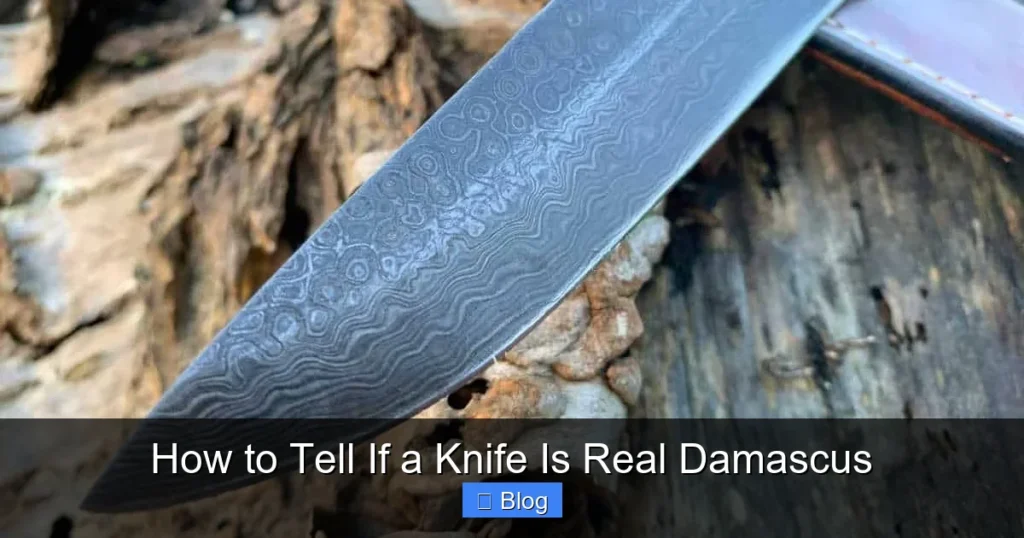
Real Damascus steel knives are prized for their stunning wavy patterns, superior edge retention, and handcrafted heritage. Unlike mass-produced imitations, authentic blades show unique, flowing layers formed through centuries-old forging techniques. This article walks you through practical ways to verify authenticity, from examining the pattern under light to understanding metallurgical properties.
If you’ve ever held a knife that felt like it could slice through dreams—and saw those mesmerizing, swirly patterns dancing across the blade—you’ve likely encountered what many call “Damascus steel.” But here’s the truth: not every knife with a cool wave design is truly forged from ancient-style Damascus. In fact, most so-called “Damascus” knives sold today aren’t made using traditional methods at all. So how do you tell if a knife is real Damascus? That’s exactly what we’re diving into today.
Damascus steel isn’t just about looks—it’s a marriage of artistry, metallurgy, and history. Originally crafted by folding layers of iron and carbon-rich steel thousands of times, these blades were legendary in warfare and craftsmanship for centuries. Today, while modern techniques have evolved, the hallmark remains the same: visible, organic layering that tells a story in every fold. Unfortunately, imitation abounds—some use simple etching, others stack flat sheets without proper heat treatment. The result? Blades that look impressive but fall short in performance and integrity.
Whether you’re a chef building your dream kitchen set, a collector hunting vintage pieces, or simply someone who appreciates finely made tools, knowing how to distinguish real Damascus from clever fakes is essential. Let’s break down the science, the sensory clues, and the smart checks you can perform right now—no lab equipment required.
Key Takeaways
- Visual Pattern Check: Real Damascus features organic, flowing swirls (like water or wood grain), not repetitive machine-made lines. Look for contrast between high-carbon and low-carbon steel layers.
- Edge Retention Test: Authentic Damascus holds a sharper edge longer than stainless-only blades—use paper or tomato to test cutting performance.
- Weight & Balance Feel: Genuine blades often feel denser and more balanced due to layered construction; counterfeits may be oddly light or unbalanced.
- Polariscope Inspection: Under polarized light, true Damascus shows distinct layer boundaries; fake patterns appear uniform or digitally enhanced.
- Acid Etching Reveals Layers: A drop of vinegar or specialized etchant exposes the layered structure—real blades develop contrasting colors where layers meet.
- Verify Seller Credentials: Buy only from reputable artisans or stores with transparent sourcing. Ask for documentation, heat marks, or maker signatures.
- Avoid Common Fakes: Watch out for “Damascus” stamped on stainless steel without actual layering, or overly perfect, symmetrical patterns that lack organic variation.
📑 Table of Contents
- What Is Real Damascus Steel?
- How to Spot the Visual Differences: Patterns That Matter
- Touch and Weight: The Tactile Truth
- Testing Performance: Cut Through Confusion
- Advanced Identification: Tools and Techniques
- Red Flags: Common Fake Indicators
- Buying Smart: Where to Find Real Damascus
- Care and Maintenance: Protect Your Investment
- Conclusion: More Than Meets the Eye
What Is Real Damascus Steel?
Before we start identifying real Damascus knives, let’s clarify what makes them special. True Damascus steel is created by forge-welding multiple layers of different steels—typically alternating high-carbon (for hardness) and low-carbon (for flexibility) alloys—then repeatedly folding and hammering the billet. Each fold doubles the number of layers, creating thousands—sometimes millions—of micro-layers fused together.
This process doesn’t just create beauty; it builds strength, flexibility, and razor-sharp edges that last far longer than monolithic stainless steel. Over time, as the layers oxidize unevenly during polishing and use, they develop a unique contrast pattern—what collectors call “hamon,” “watery,” or “mokume-gane” depending on regional styles.
Modern Damascus uses similar principles but often incorporates stainless or tool steels like 1095, 15N20, or 416R for consistency. Crucially, **authentic Damascus must have actual folded layers**, not just painted or laser-etched designs. Many inexpensive “Damascus-style” knives use a single piece of stainless steel with surface engraving—a big red flag!
How to Spot the Visual Differences: Patterns That Matter
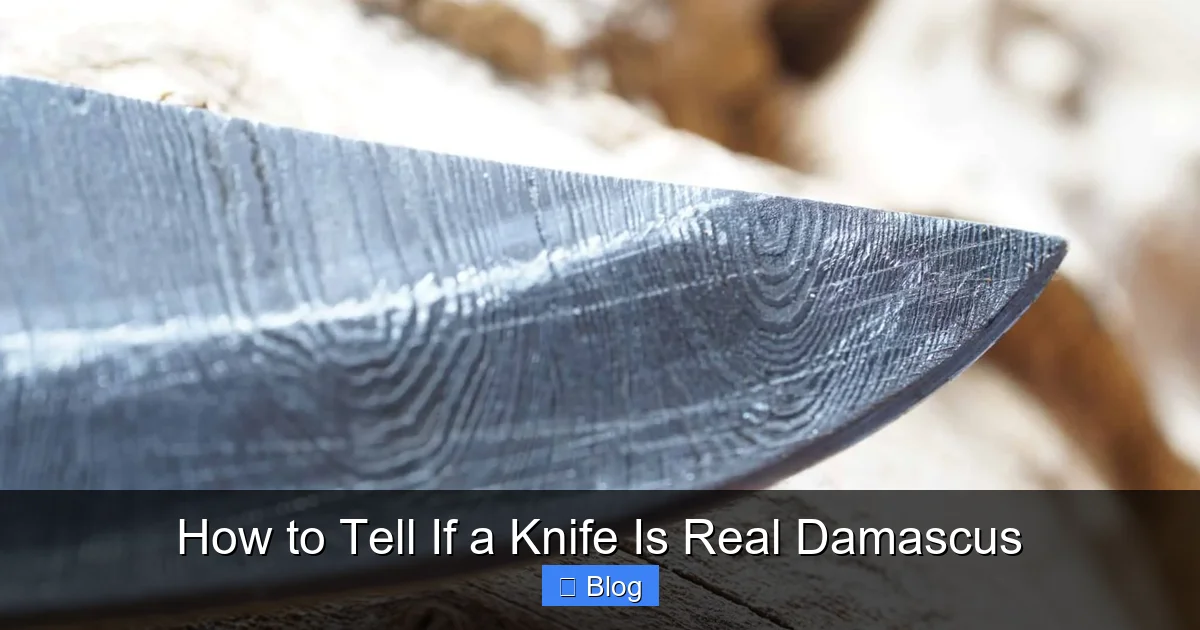
Visual guide about How to Tell If a Knife Is Real Damascus
Image source: knifeade.com
The first thing your eyes catch when holding a Damascus knife is its pattern. But not all patterns are created equal. Here’s how to read them like a pro:
Look for Organic Flow, Not Repetition
Authentic Damascus patterns resemble natural phenomena—think flowing water, tree rings, or marble veining. These should appear random, asymmetrical, and fluid. If the waves repeat in exact, geometric rows like stripes on a shirt, it’s almost certainly fake. Real folds create chaotic, beautiful chaos.
Try tilting the blade under bright light. Genuine layers will shift color subtly as you rotate it—lighter and darker bands merging into soft gradients. Fake ones stay flat and dull.
Check Layer Contrast
Under good lighting, you should see clear boundaries between light and dark bands. These represent alternating layers of high- and low-carbon steel reacting differently to polishing and oxidation. The contrast shouldn’t be too sharp or artificial—imitation patterns often look “too perfect.”
Also, notice if some areas seem artificially highlighted or shaded. Some cheap fakes spray paint or coat the surface to mimic depth. Wipe gently with a clean cloth—if pigment comes off, it’s not real.
Examine the Edge Line
Where the blade meets the handle (the “choil” area), authentic Damascus usually shows thicker, more pronounced layers. This is because artisans fold less near the tip for control and more toward the spine for structural integrity. Fake blades often have uniform thickness everywhere—even where it doesn’t make sense.
Hold the knife sideways and run your thumb along the edge line. You might feel slight ridges—those are the beginnings of folded layers. Smooth, seamless transitions suggest machining, not forging.
Touch and Weight: The Tactile Truth

Visual guide about How to Tell If a Knife Is Real Damascus
Image source: knifeade.com
Beyond sight, your hands know best. Real Damascus knives carry weight and balance that reflect their complex construction.
Feel the Density
True Damascus feels heavier than expected for its size—not bulky, but substantial. Why? Because each layer adds mass without increasing bulk. Compare it to a plain stainless knife of the same length: if yours feels noticeably heavier, that’s a clue.
Conversely, avoid blades that feel hollow or tinny when tapped lightly. Poor-quality imitations often use thin, glued laminates that rattle or sound empty.
Balance Matters
Hold the knife at rest point (where your index finger naturally rests). A well-made Damascus should feel centered—not nose-heavy (common in cheap knockoffs) nor tail-heavy (which throws off slicing motion).
Practice slicing soft foods like tomatoes or paper. If the knife wobbles wildly or requires extra force, the balance is off. Real artisans tune weight distribution during final shaping.
Testing Performance: Cut Through Confusion
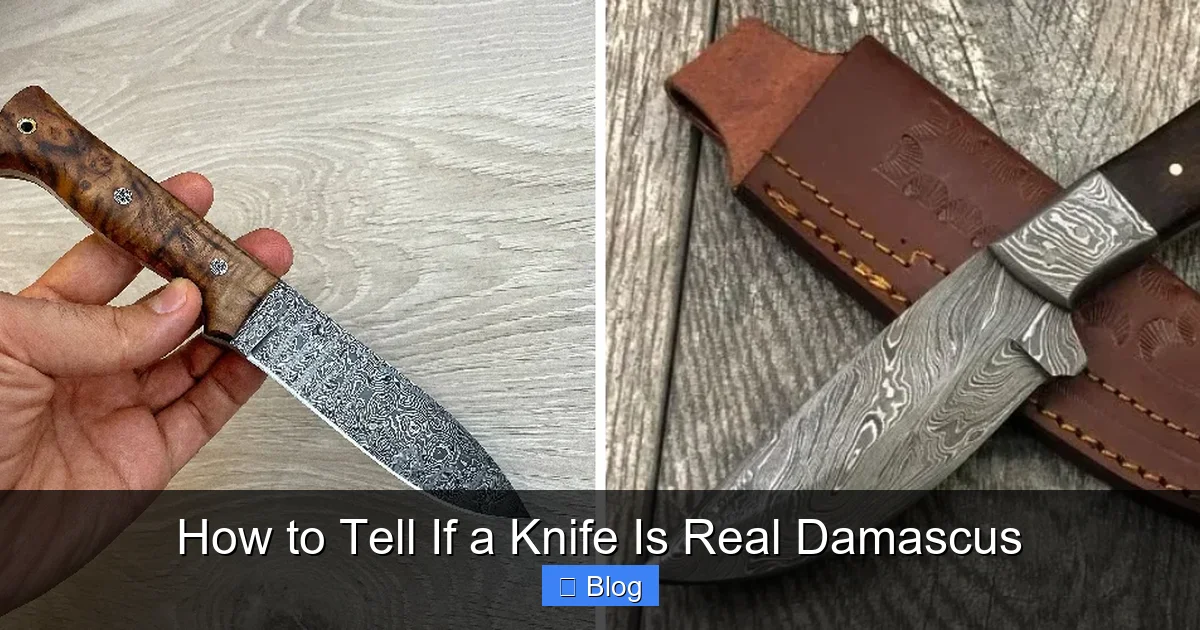
Visual guide about How to Tell If a Knife Is Real Damascus
Image source: metalfixes.com
Looks and feel matter—but function seals the deal. Authentic Damascus excels in two key areas: sharpness and longevity.
Paper Test
Fold a sheet of standard printer paper in half and hold it taut. Slice once cleanly through the middle. Repeat three times. Real Damascus should cut effortlessly each time, leaving crisp edges. If the blade drags, bends the paper, or tears unevenly, it lacks proper hardness—likely a fake.
Note: Be gentle! Over-testing can damage even genuine blades.
Tomato Carving Challenge
Take a ripe tomato. A real Damascus knife should glide through skin without crushing pulp. Look for a smooth exit wound—no ragged edges or compression. This tests both sharpness and tip precision.
Fake blades often crush instead of slice because they rely on blunt tips or poor geometry.
Edge Retention Comparison
Use the knife daily for a week (or simulate usage). Then repeat the paper test. High-end Damascus retains its edge far longer than stainless-only knives. If yours becomes dull after just a few cuts, suspect filler materials or improper tempering.
Pro Tip: Store Damascus properly—never leave wet food soaking in the blade. Rust spots mean it’s not fully protected against corrosion.
Advanced Identification: Tools and Techniques
For serious buyers or collectors, deeper inspection reveals even more truths.
Polariscope Testing
A polariscope (available online for under $100) uses polarized light to expose internal stress lines and layer boundaries. When shone on a real Damascus blade, you’ll see crisp, intersecting lines forming a unique fingerprint. Fakes show no such detail—just uniform brightness.
While this requires investment, rental services exist at knife shows or via professional appraisers.
Acid Etching Reveal
Dip a corner of the blade in diluted white vinegar (5% acetic acid) for 1–2 minutes. Then rinse and dry. Authentic layers will oxidize differently: high-carbon areas turn dark gray/black; low-carbon stay lighter. This mimics traditional “forge etching” used by master smiths.
Warning: Do this only on non-working edges! Etching ruins usability.
Alternatively, buy commercial etchants (available from knife supply stores). They react faster and safer.
Magnetic Test (With Caveats)
Some Damascus blends include magnetic stainless steels (like 416). But pure 1095/15N20 Damascus is non-magnetic. Tap the spine with a magnet. If it sticks firmly, expect mixed metals—possibly authentic but not traditional.
However, many reputable makers now use magnetic cores for rust resistance. So don’t rely solely on magnetism.
Red Flags: Common Fake Indicators
Even without tools, you can spot fakes by watching for these warning signs:
– **Stamped “Damascus” on stainless steel**: Legally allowed but technically misleading. No folding = no real layers.
– **Overly symmetrical patterns**: Nature doesn’t create perfect mirrors. Real folds are messy.
– **Paint or epoxy coating**: Feels sticky or peels off. Authentic finishes are oil-based or polished bare steel.
– **Rust immediately after washing**: Real Damascus resists corrosion—especially if cared for properly.
– **No maker mark or heat signature**: Reputable artisans sign their work. Absence raises suspicion.
Remember: If a $50 knife claims to be “hand-forged Damascus,” laugh politely and walk away.
Buying Smart: Where to Find Real Damascus
Never assume every online listing is honest. Seek out:
– **Master smiths** with years of experience (check Instagram or YouTube for behind-the-scenes videos)
– **Reputable dealers** attending knife expos (Blade Show, Atlanta Knife Expo)
– **Brands like Shun, J.A. Henckels Pro, or Zwilling** offer licensed Damascus lines with certificates
– **Reviews from trusted sources** like Serious Eats, Cook’s Illustrated, or Knife Steel Nerds
Ask sellers directly: “Can you show me the folded layers under magnification?” Most real craftsmen won’t mind.
Also, compare prices. Authentic Damascus takes 100+ hours to forge. Expect to pay $150–$800+ depending on complexity and materials.
Care and Maintenance: Protect Your Investment
Once you confirm your knife is real Damascus, treat it like royalty:
– Hand wash only; dry immediately
– Oil the spine and bolster occasionally (mineral oil works great)
– Use wooden or bamboo cutting boards—never glass!
– Sharpen with ceramic rods or whetstones (avoid aggressive diamond stones)
Proper care preserves both beauty and function. Neglect leads to pitting and loss of pattern definition.
Conclusion: More Than Meets the Eye
Telling if a knife is real Damascus blends art, science, and intuition. It starts with trusting your eyes to spot organic flow over artificial repetition, then validates with touch, performance, and smart questions. Advanced tools like polariscopes offer certainty, but everyday folks can learn enough to avoid obvious fakes.
At the end of the day, a true Damascus knife isn’t just a tool—it’s a conversation starter, a heirloom in waiting, and proof that skillful human hands can still create something extraordinary. Whether you’re slicing sushi or opening packages, knowing how to identify real Damascus empowers you to choose wisely—and appreciate the craft behind every cut.
Now go forth! Inspect carefully, test thoroughly, and never settle for less than authentic excellence.
Frequently Asked Questions
Can I really tell real Damascus by looking at it?
Yes, with practice. Authentic Damascus shows organic, flowing patterns unlike the repetitive lines of fakes. Look for asymmetry, color contrast, and natural-looking swirls under light.
Do all Damascus knives need to be magnetic?
No. Traditional 1095/15N20 Damascus is non-magnetic. However, many modern versions include magnetic stainless steels for rust resistance, so magnetism alone can’t prove authenticity.
Is acid etching safe for my knife?
Only on non-working edges. While it reveals layer structure safely, etching damages the blade’s protective oxide layer and reduces value. Never use on primary cutting surfaces.
Why do some “Damascus” knives rust easily?
If improperly finished or made from low-grade materials, even real Damascus can corrode. Always dry immediately after use and store with a light coat of mineral oil.
Are Japanese Damascus knives better than Western ones?
Not inherently. Both regions produce exceptional Damascus using similar folding principles. Quality depends on the smith, not origin. Research individual makers rather than assuming geography equals superiority.
Can I sharpen a real Damascus knife myself?
Absolutely—but gently. Use fine-grit whetstones (2000+ grit) and avoid excessive pressure. Regular maintenance preserves both edge and pattern integrity over decades.