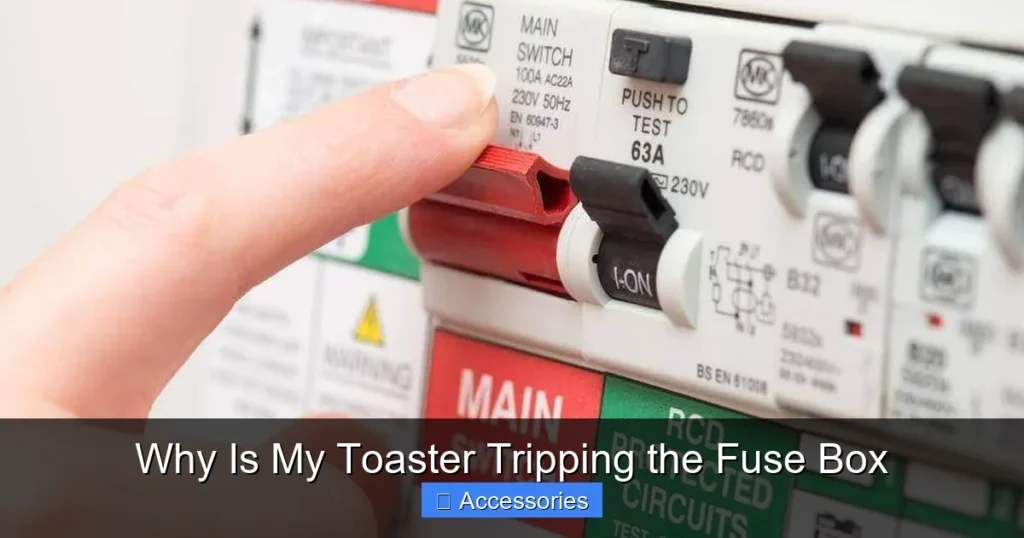
Why is my toaster tripping the fuse box? This frustrating issue often stems from electrical overloads, worn-out components, or circuit problems. Most of the time, it’s fixable with simple troubleshooting—like checking wattage, inspecting cords, or testing other appliances on the same circuit.
Why Is My Toaster Tripping the Fuse Box?
There’s nothing more annoying than reaching for your morning toast only to find the lights flicker and the breaker shut off. You reset it, try again—and bam! It trips once more. If you’re wondering, why is my toaster tripping the fuse box, you’re not alone. This common household puzzle has several possible causes, ranging from simple user error to hidden electrical hazards. But don’t panic—most of these issues are fixable with a bit of detective work and basic knowledge.
Before we dive into solutions, let’s clarify what happens when a toaster “trips” the circuit. In North America, homes typically use either fuses (older systems) or circuit breakers (modern setups). Both serve the same purpose: protecting your wiring from overheating due to excessive current. When too much electricity flows through a single circuit—like when your toaster kicks in along with a microwave and coffee maker—the protective device cuts power to prevent fire risk. That’s exactly what’s happening when your toaster triggers the fuse box or breaker panel.
Understanding how household electricity works is key to solving this problem. Let’s explore the most likely reasons behind why your toaster keeps tripping the fuse box—and what you can do about it.
What Causes a Toaster to Draw Too Much Power?
Toasters are notorious for sucking up a lot of juice from your home’s electrical system. Unlike LED bulbs or phone chargers, they rely on powerful heating elements that convert electricity into intense heat—fast. A typical countertop toaster uses between 1200 and 1800 watts at 120 volts. That translates to roughly 10 to 15 amps! Now, if your home’s circuit is rated for just 15 amps total, running the toaster while another high-wattage device (like a blender or microwave) is already active pushes things dangerously close to capacity.
For example, imagine you plug in your toaster into an outlet that also powers your refrigerator. The fridge runs continuously but cycles on and off; its motor might pull 6–7 amps during startup. Add the toaster’s full load (~12 amps), and you’ve hit 18+ amps—well beyond what a standard 15-amp circuit can safely handle. Even without exceeding the limit, voltage drop and momentary spikes can confuse sensitive breakers into thinking there’s a fault.
Another hidden factor? Poor connections. Loose prongs in the plug or corroded contacts inside the outlet reduce efficiency and force the toaster to work harder—drawing even more current than usual. This inefficiency heats up the internal wiring and increases strain on the circuit.
How Do I Know If My Toaster Is the Real Culprit?
Sometimes, the real problem isn’t the toaster itself—it’s the environment around it. Before blaming your appliance, ask yourself: Are other appliances sharing the same circuit? Have you noticed flickering lights or dimming when the toaster runs? Does it happen only when specific devices are active?
Start by unplugging everything else connected to that outlet or circuit. Plug in only the toaster and turn it on. If the breaker doesn’t trip, the issue is likely a shared-load scenario. But if it still flips, then your toaster may have an internal fault.
Common signs include:
– Burning smells
– Visible damage to the cord or plug
– Sparks near the base
– Inconsistent browning despite normal operation
If any of these apply, stop using the toaster immediately. Continuing could damage your home’s wiring or pose a shock hazard.
Could Faulty Internal Components Be the Issue?
Inside every toaster, there are two critical parts responsible for managing heat: the heating elements and the thermostat/bimetallic strip. These components regulate how long the coils stay hot based on your selected setting (light, medium, dark).
Over time, both can degrade. A stuck thermostat might keep the elements powered continuously, causing runaway heating and massive current draw. Similarly, cracked ceramic insulators or broken wire joints inside the housing can create arcing or short circuits.
In older models, especially those made before energy-efficient designs became standard, manufacturers used heavier-gauge nichrome wire that drew more power than necessary. While reliable, these units were less forgiving under electrical stress.
Modern toasters often include built-in safety features like thermal fuses that cut power if overheating occurs. But if those fail—or aren’t present—you’re left vulnerable to trips, fires, or melted sockets.
Should I Check the Circuit Breaker Panel?
Absolutely. Your fuse box or breaker panel holds clues about why your toaster keeps tripping. First, identify which breaker controls the outlet where your toaster plugs in. Look for a label or trace the wires back to the panel.
Next, check if the breaker feels warm or shows scorch marks around its terminals. Warmth suggests loose connections or repeated overloads. Also, note whether the breaker trips instantly or after a few seconds. Instant trips usually mean a dead short (e.g., live wire touching neutral), while delayed trips often indicate gradual overload.
If you see burn marks, smell ozone, or hear crackling sounds, call a licensed electrician immediately. DIY repairs on main panels can be dangerous and may void warranties.
Is Shared Circuit Usage Really That Dangerous?
Yes—and it’s one of the top reasons why people wonder, why is my toaster tripping the fuse box. Many kitchens weren’t designed with today’s gadget-heavy lifestyles in mind. Older homes often route multiple outlets through a single 15-amp circuit, meaning everything from your toaster to your air fryer competes for limited power.
Consider this real-life scenario: Maria plugs her toaster into a duplex outlet near the counter. Later, she uses her food processor nearby—also plugged into the same circuit. Her toaster starts smoking and then the breaker clicks off. Why? Because both appliances together exceeded safe limits.
Even seemingly low-power devices add up. An air fryer uses ~1500W, a microwave ~1000W, and a coffee grinder ~300W. Combine them with a toaster, and you’re asking for trouble.
The solution? Use dedicated circuits for high-draw appliances whenever possible. Many new homes include separate 20-amp lines for kitchen counter outlets—but retrofitting old ones requires professional help.
What About Ground Faults and Moisture Exposure?
Moisture is another sneaky enemy of electrical safety. If your toaster sits near a sink or gets splashed during cleaning, water can seep into the housing. Once inside, it creates a path for electricity to “leak” to ground—triggering the GFCI (ground fault circuit interrupter) in modern outlets.
GFCIs are designed to detect imbalances as small as 4–6 milliamps. That’s enough to protect against shocks but small enough to catch minor ground faults before they become serious.
Signs your toaster might be affected:
– Tripping only when wet or near water
– Frequent resets after brief use
– Visible rust or mineral deposits inside the slots
If you suspect moisture damage, unplug the toaster, dry it thoroughly, and inspect for corrosion. Never operate a damp appliance until fully dried and inspected.
When Should I Replace My Toaster?
Appliances have lifespans, just like cars. Most countertop toasters last 5–10 years under normal use. After that, internal components wear out, efficiency drops, and repair costs outweigh replacement value.
Ask yourself:
– Has it been more than 7 years?
– Does it brown bread unevenly or take forever to heat up?
– Are you constantly resetting breakers?
– Does it make unusual noises or smell burnt?
If you answered yes to three or more, it’s probably time for a new model. Modern toasters come with improved safety features, better temperature control, and energy-saving modes—all while using slightly less power.
Plus, upgrading reduces future headaches. Newer designs often include auto-shutoff, crumb trays that slide out easily, and wider slots for bagels or artisanal breads.
How Can I Prevent Future Tripping Issues?
Prevention starts with smart habits:
– Avoid plugging high-wattage devices into the same outlet or circuit.
– Use surge protectors with built-in circuit monitoring (though they won’t solve overloads—just filter spikes).
– Keep toaster cords away from sinks and wet surfaces.
– Clean crumbs regularly—they conduct heat and insulate elements, forcing them to work overtime.
– Inspect cords monthly for fraying, cracking, or exposed wires.
Also, consider rewiring your kitchen if you frequently host dinner parties with multiple appliances running at once. While expensive upfront, it pays off in safety, convenience, and peace of mind.
Can I Fix the Problem Myself?
Simple checks? Definitely. Try swapping the toaster into a different outlet—ideally one on its own circuit—to rule out outlet-related issues. Test with only the toaster running; if it works fine, the original outlet or circuit is likely overloaded.
But never attempt deep repairs unless you’re trained in electronics. Heating elements are under high tension, and tampering without proper tools/skills risks electrocution or fire.
When in doubt, consult a qualified technician. They can test amperage draw, inspect internal wiring, and recommend upgrades like AFCI (arc-fault) breakers for added protection.
Final Thoughts: Don’t Ignore the Warning Signs
Tripped breakers aren’t just inconvenient—they’re your home’s way of saying, “Hey, something’s wrong.” Ignoring repeated trips can lead to overheated wires, melted outlets, or worse. By understanding why your toaster keeps tripping the fuse box, you take control of both safety and convenience.
Remember: It’s usually not the toaster alone—it’s the combination of usage patterns, wiring age, and appliance interactions. With a few smart changes, you can enjoy perfectly toasted bread without fear of blowing a fuse.
And hey—if your toaster’s seen better days, consider upgrading. Newer models are safer, smarter, and often more efficient. Plus, you’ll avoid future trips and sleepless nights wondering if your kitchen’s about to go up in smoke.
Key Takeaways
- Toasters draw high current: Most toasters use 1200–1800 watts, which can overload a standard 15-amp circuit if multiple devices run simultaneously.
- Faulty heating elements or thermostats: Overheating or stuck components cause excessive power draw, triggering the breaker.
- Damaged power cord or plug: Frayed wires create resistance, leading to sparks, heat buildup, or short circuits.
- Shared circuits are common culprits: If your toaster shares a circuit with microwaves, blenders, or refrigerators, even small surges can trip the fuse.
- Older wiring may not handle modern loads: Homes built before 1960 often have outdated systems that can’t safely support today’s kitchen gadgets.
- Ground fault risks increase with age: Worn insulation or moisture exposure raises the chance of ground faults—a safety feature that trips the breaker.
- Testing helps isolate the problem: Unplugging other devices or using a different outlet can confirm whether the issue is appliance-specific or electrical.
Frequently Asked Questions
Why does my toaster trip the breaker every time I use it?
This usually happens because the toaster draws too much power—often 1200–1800 watts—which exceeds the capacity of a standard 15-amp circuit. If other devices share the same circuit, the combined load can trigger the breaker. It could also indicate a faulty thermostat, damaged heating element, or worn-out wiring inside the toaster.
Can a faulty toaster cause a fire hazard?
Yes. If the heating elements overheat due to a broken thermostat or cracked insulation, they can ignite nearby materials or melt plastic components. Repeated tripping without inspection increases fire risk. Always unplug a toaster showing signs of damage—burning smells, sparks, or discoloration—until it’s repaired or replaced.
How many watts can a standard circuit handle?
A standard 15-amp circuit at 120 volts can safely handle up to 1800 watts (15 × 120 = 1800). However, experts recommend staying under 1500 watts to allow for safe margin during startup surges. Circuits labeled 20-amp support up to 2400 watts and are ideal for kitchens with multiple high-draw appliances.
Do all outlets share the same circuit?
Not necessarily. In newer homes, kitchen counter outlets often run on dedicated 20-amp circuits. But in older houses, multiple outlets—including those behind counters, above islands, or near sinks—may share a single 15-amp line. Check your breaker panel labels or hire an electrician to map your home’s wiring.
Can I use a power strip with my toaster?
Only if the power strip has its own circuit breaker and is rated for continuous high loads (at least 1800 watts). Standard power strips lack overload protection and can overheat when stressed. For best results, plug high-wattage appliances directly into wall outlets.
How do I know if my toaster needs replacing?
If your toaster is over 7 years old, browns bread inconsistently, takes longer to heat, emits burning odors, or frequently trips breakers, it’s likely time for a new one. Modern toasters offer better safety features, energy efficiency, and reliability compared to older models.